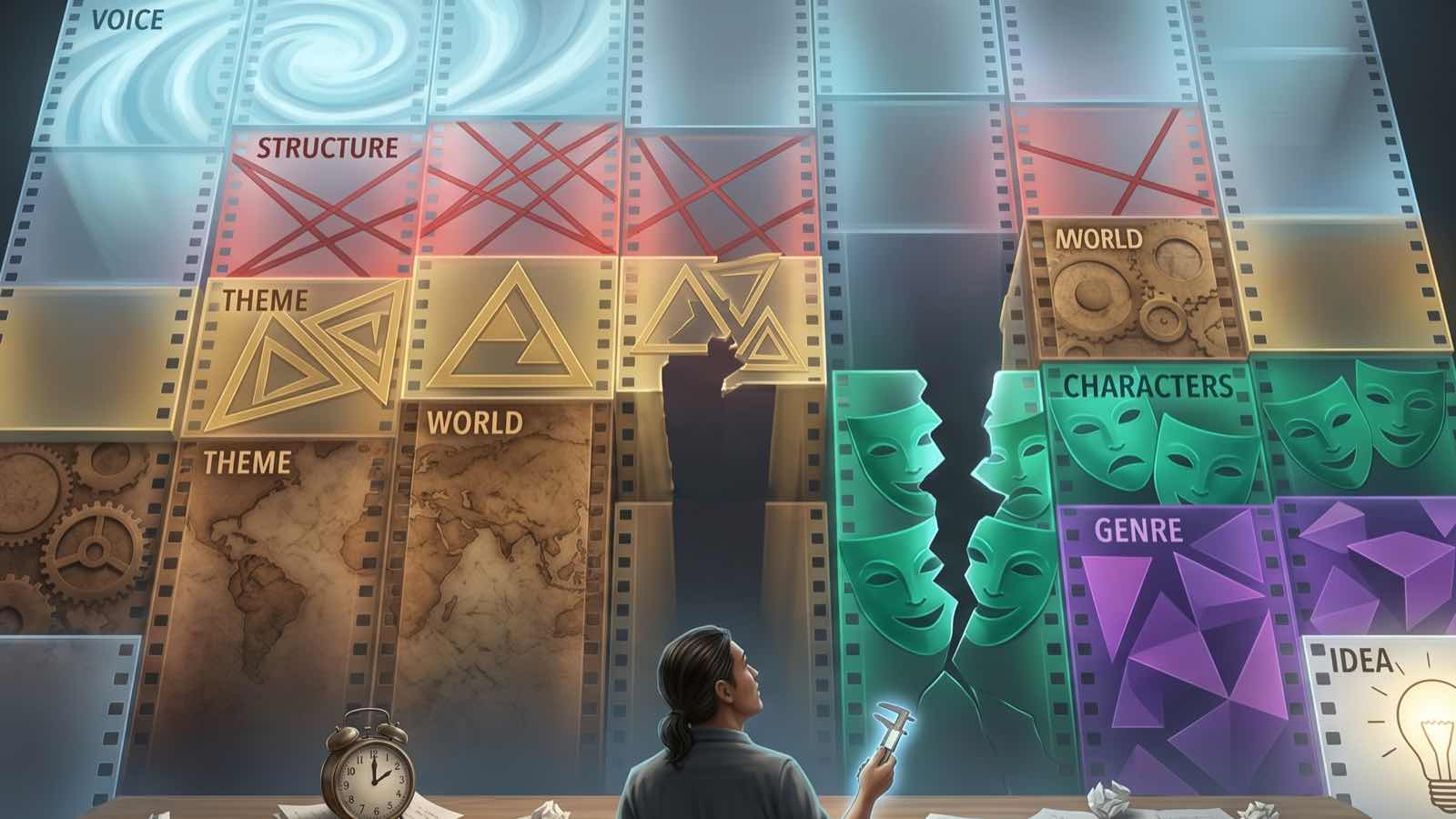
The draft has been in progress for two years. You know the file. You know which folder. You may have, at one point, given it a working title, and you have certainly given it more than one. It exists. It will not finish. Every time you open it, you read the first three chapters, find them roughly where you left them, change two sentences, close the file. The motivation is intact. The will is intact. The work is not happening.
The first thing to know is that this is not a failure of will. It is almost never a failure of will. The pattern of open file, polish, close is what writers do when there is a structural fault upstream that the writer is, without quite recognising it, trying to fix at the prose level. The sentences in chapter one are not actually broken. The thing that is broken is something the chapter rests on, several layers down, and the writer cannot move forward because forward motion would propagate the fault into more of the manuscript than has already been compromised. The polishing is a holding pattern. It feels like cowardice. It is not cowardice. It is the writer's structural intuition refusing to commit more work to a foundation that knows itself to be wrong.
The second thing to know is that this is recoverable. The diagnostic is precise.
The recovery move is what Scribbard calls the diagnostic-reverse. Read the manuscript backwards through the seven layers — Voice, Structure, Theme, World, Characters, Genre, Idea — and find the earliest layer where the chain breaks. In a coherent draft, every layer's condition is explained by the layer immediately beneath it. Voice is explained by Structure (the POV is determined by what the structure required the reader to know). Structure is explained by Theme (the midpoint reverses something the story has actually argued). Theme is explained by the collision of World and Character (the argument is the specific argument this protagonist's misbelief, in this specific world, generates). And so on, down. When the chain breaks — when a layer is explicable only as instinct, or as authorial choice, or as "I don't know, that just felt right" — that is the source.
The break is almost never where the symptoms are. The symptoms are usually in the prose, because that is what the writer is staring at. The fault is usually two or three layers down. (The most common location, by some distance, is Theme. The second most common is the protagonist's Misbelief — which is, technically, a Character problem, but propagates upward as a Theme problem because without a committed misbelief there is no collision and therefore no argument.) The diagnostic-reverse asks one question per layer. Voice: is the POV justified by the structure's informational requirements? Structure: do the act breaks correspond to specific shifts in the thematic argument? Theme: is the central argument provable from the character-world collision? World: do the world's pressure points target this protagonist's specific psychology? Characters: does the protagonist carry a specific Misbelief? Genre: is the genre the right contract for this idea?
Work down the questions until you find one that the manuscript answers with "no, actually." That is the layer that is broken. That is where the rebuild begins.
The rebuild is the smaller half of the work. Most of the manuscript above the fault is salvageable. (This is the news that nobody quite believes when first told. It is true. The chapters you have already written are mostly not waste; they are notes, written in prose, on the version of the story whose architecture you didn't yet know you needed to commit. They will be revised heavily. They will not be discarded.) Commit the broken layer correctly. Recalculate downstream. The world that was generic becomes targeted; the theme that was asserted becomes earned; the structural beats that were dramatic-but-arbitrary become specific. Many existing scenes survive recalibration with surprising fidelity, because the writer's instincts were partially right; what was missing was the architecture that would have let those instincts compound into a coherent whole.
This is what Scribbard's import flow does, mechanically. Upload the manuscript. The system runs the diagnostic-reverse — extracting the layers from the existing prose in reverse dependency order, surfacing what the draft knows about itself and what it doesn't, identifying which layer is the earliest uncommitted one. The output is not a verdict on the draft. It is a map. (The map is the thing most writers in this position have never had. The reason recovery feels impossible from the inside is that, from the inside, the writer has spent two years staring at the chapter where the symptoms are visible. The map is what makes them stop staring there and start working where the fault actually is.)
You can do this without the platform. The diagnostic is real either way. Read the manuscript with the seven questions open beside you. Be honest about which layer can and can't explain its neighbour. The earliest broken layer is the answer.
A few practical notes. Do not begin by rereading the manuscript chronologically. That is what you have done a hundred times, and it has never produced the diagnosis. Read the layers, not the pages. Do not start the rebuild before you have committed the broken layer in writing. The temptation to begin patching scenes the moment the fault is named is strong; resist. The patches will be wasted if the layer beneath them is not committed first. And do not throw the manuscript out. The manuscript is your evidence — it is what you have been telling yourself the story is for two years, in prose. The new architecture will use almost all of it.
The reason stalled drafts feel like a permanent condition is the same reason fog feels like a permanent condition: from the inside, there is no horizon. The diagnostic-reverse gives you the horizon. The rebuild moves toward it. Two years of standing still becomes a project with a known shape and a knowable timeline. It is not always quick — three months is realistic; six is possible — but it is bounded. That is the news.
The draft is not abandoned. It was never abandoned. It was waiting for the diagnosis. It has been there the whole time.