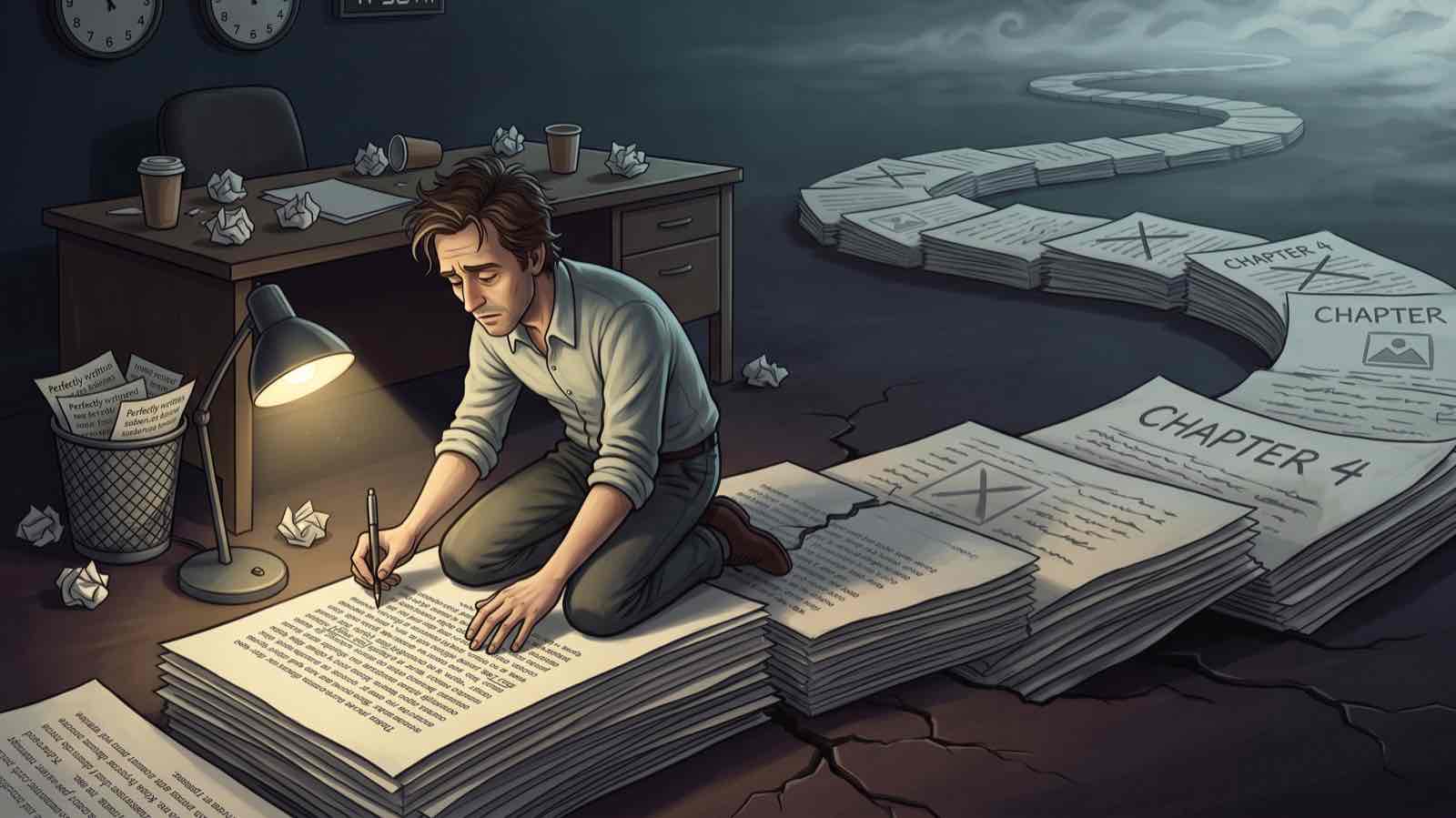
It is past eleven. You are on the third version of paragraph two. The first version was fine. The second version was a slight improvement of one clause and a slight worsening of another, balancing out to fine. The third version has done something to the rhythm of the second sentence that may be better, may be worse, may have introduced a subtle problem in the connective tissue with the paragraph following it. You are about to start a fourth version. The chapter you intended to write tonight has not been written. It is not, at this point, going to be.
This is not laziness. It is not avoidance, exactly. It is the most expensive form of procrastination in the writer's repertoire, and it is the one writers reach for precisely because it does not feel like procrastination. Every other form of not-writing announces itself as not-writing. Tidying notes is visibly not writing. Reading novels is visibly not writing. Tweaking paragraph two is — in some narrow technical sense — writing. The sentence got better. The story didn't. By morning, none of the better sentences will matter, because the chapter the paragraph is in cannot reach its end while you remain inside one paragraph.
The behaviour is universal. The reason is simple. Generation forward is hard. Every word forward is a commitment that didn't exist a moment ago, made in conditions of imperfect information, into a future the writer cannot yet see. Revising an existing sentence, by contrast, is bounded. The sentence is right there. The change is small. The cost is low. The dopamine is comparable. (One of these is not actually true, and we'll get to it.) The brain, which has not been told it is supposed to be producing a draft and not optimising one, does what brains do: it picks the bounded task over the unbounded one. The hours pass.
The cost the brain has not been told about is the cost of revising sentences before the structure is locked. It is a real cost, and it is much larger than the time spent. Every line-edit made to a sentence inside an unfinished chapter is an edit you may delete entirely when the chapter changes — and the chapter will change, because chapters in a draft change shape in response to the chapters that come after them. The character revealed in chapter eight that you haven't written yet will revise something the protagonist said in chapter four. The structural beat you are about to discover in chapter twelve will require chapter six to land differently. The polish work is real work — the third version of the paragraph genuinely is better than the second — and most of it will be erased, because the paragraph itself will be rewritten when its structural function shifts. The labour is not stored. It is consumed at the moment of structural revision and gone.
This is the math. Time spent line-editing in the first draft is mostly subtracted. Time spent producing rough next-scene prose is mostly preserved. The first feels productive and is not. The second feels uncomfortable and is.
There is a hard rule worth taking seriously. If you find yourself revising the same paragraph three times, the problem is not the paragraph. The third visit is the diagnostic. The first revision was reasonable; the second was probably justified; the third is a signal. The reason the paragraph cannot be made to settle is, almost always, that the architecture beneath it is not yet stable enough for any version to be the right one. The paragraph cannot land because what it lands into has not been written. The fix is not a fourth version. The fix is to stop and write what comes after.
(This is one of the small, brutal facts of the work. The sentences you cannot stop fixing are most often the ones whose context does not yet exist. They are not bad sentences. They are early sentences, demanding to be made finished, by a writer who has not yet given them a context to be finished into.)
The discipline is deferred polish. It is uncomfortable to begin, and it is the single most reliable speed-up the work has on offer. The shape of it: write rough through the architecture. Sentences are placeholders for what those sentences are doing. Get the chapter done — done, not good — then move to the next chapter. Through the act, through the second act, through the climax, through the resolution. Polish, finally, in revision — when the architecture is locked, when the sentences have a stable context to land into, when the line you were about to spend three versions on either still exists or has been deleted entirely. (Most often: deleted, or unrecognisably altered. The third version of paragraph two was always going to be rewritten as the seventh version of paragraph two, by a writer who knew what paragraph eighty-four was going to be. That writer did not exist tonight. That writer is two months and forty thousand words from here.)
A few practical instruments. Some writers find a hard cut-off useful — a rule that disallows any sentence-level revision before the chapter is complete, enforced mechanically by writing into a separate file and not opening yesterday's. Others use a notation move: when the urge to revise a sentence becomes specific, leave a square bracket — [awkward, fix later] — and continue forward. The bracket is a record; the forward motion is preserved. (Scribbard's chapter editor allows the same instinct as a habit: the comment, the deferred-pass marker, the note-to-future-self that lets the present-self keep typing.) Either move converts the energy of the line-edit into useful trace data for the revision pass that will, eventually, address it from above instead of from inside.
The deeper trick is permission. The first draft is allowed to be ugly. Rough, even. Wrong in places. Wrong in places that you can already see being wrong, which is a particular discomfort that has to be borne for the shape of the work to come together. The first draft's job is to exist. The second draft's job is to be good. The two are different jobs and they cannot be done simultaneously, however much the brain at eleven on a Tuesday wants to insist that they can.
Close the file on paragraph two. Open the file on chapter four. Write what happens. Tomorrow you will have written something you didn't have tonight, and the paragraph that has been bothering you will, at minimum, be no worse than it is now.
That is the trade. Take it.